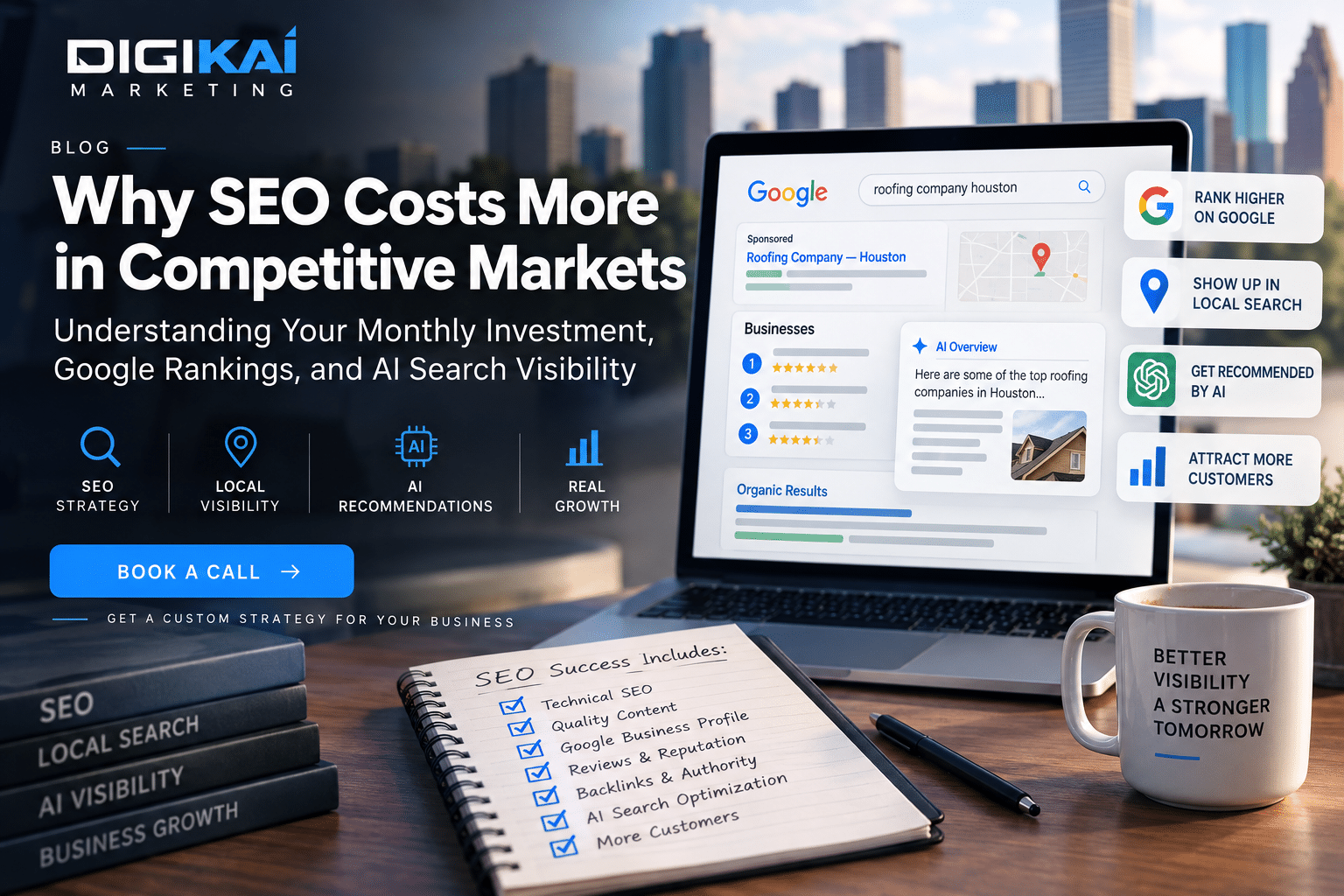
Understanding Your Monthly Investment, Google Rankings, and AI Search Visibility
Introduction
If you’re spending $2,000, $3,500, or even $5,000 per month on SEO and wondering why your business isn’t ranking in Google’s top three positions, consider this: your budget doesn’t exist in a vacuum. You’re competing against companies that may have spent years building their online presence. Search has become more competitive, Google’s results are more complex, and AI-powered discovery adds another dimension. At DigiKai Marketing, we believe business owners deserve a clear explanation of what their investment can realistically achieve.
Why Google’s Top Three Are Harder to Reach
In many markets, well-optimized pages, business listings, and a modest link-building effort once delivered strong results. Today, a Houston roofing company may compete with firms that have invested in SEO for five to ten years, built extensive service content, earned relevant links, accumulated hundreds of reviews, and developed recognizable local brands. A new competitor isn’t just competing with those firms’ current monthly budgets; it is competing with years of accumulated work and trust. More money doesn’t guarantee a ranking, but adequate resources allow more of those gaps to be addressed.
Google’s First Page Has Changed
Search results can include sponsored ads, Local Services Ads for eligible businesses, Google Maps, AI Overviews, featured snippets, and traditional organic results. Even the first organic listing can appear below other features. Organic SEO aims to improve website rankings; local SEO aims to improve visibility for geographically relevant searches and Maps. Google identifies relevance, distance, and prominence as key local ranking factors. A business far from the searcher may struggle to enter the local three-pack despite a substantial SEO budget. No ethical agency can guarantee a top-three placement.
How Much Should You Spend Each Month?
There is no universal budget that guarantees results. The ranges below are illustrative planning scenarios, not verified industry averages, fixed DigiKai packages, or ranking guarantees. Actual pricing depends on competitive research, scope, and delivery costs.
| Market situation | Illustrative monthly budget |
| Smaller market, limited competition | $1,500–$3,000 |
| Established local competition | $3,000–$5,000 |
| Competitive metropolitan market | $5,000–$8,000 |
| Extremely competitive market / broad campaign | $8,000–$15,000+ |
A $3,500 campaign may be sufficient for meaningful progress in one market, while supporting only a portion of the necessary work in another. The right question is not simply “What does SEO cost?” but “What will it take to compete in my market?”
What Your Monthly SEO Investment Actually Pays For
SEO is not just adding keywords or publishing occasional blogs. An effective campaign may include all of the following, prioritized to match the available budget:
Technical SEO and website performance
Crawlability, indexing, redirects, duplicate content, canonical tags, XML sitemaps, mobile usability, Core Web Vitals, structured data, internal links, and site architecture.
Keyword research and search intent
Researching commercially valuable searches, customer intent, competition, geography, and the services most likely to generate qualified leads.
On-page SEO and content
Improving titles, headings, service pages, useful local pages, FAQs, case studies, project galleries, images, and calls to action. Quality and originality matter more than publishing large numbers of near-identical pages.
Google Business Profile and local SEO
Accurate categories and business details, service information, authentic photos, profile maintenance, local citations, and adherence to Google’s business representation rules.
Reviews and reputation
Encouraging authentic customer feedback, responding professionally, and strengthening customer trust without buying reviews or manipulating ratings.
Backlinks, authority, and digital PR
Earning relevant editorial links and mentions through useful resources, industry relationships, community activity, and legitimate coverage—not buying manipulative links.
Conversion optimization
Improving navigation, forms, click-to-call, scheduling, trust signals, landing-page messaging, and mobile usability so more qualified visitors become leads.
Measurement and reporting
Tracking organic clicks, relevant rankings, Google Business Profile interactions, qualified calls, forms, conversions, and attributable revenue where measurement allows.
What Does It Take to Get Recommended by AI?
Customers now use tools such as ChatGPT, Gemini, and Perplexity to research and compare businesses. AI systems vary: some retrieve current web sources while others combine retrieved information with learned patterns. No agency can guarantee a recommendation, and there is no single universal “AI ranking.”
An AI search visibility strategy includes clearly stating who your business serves and where; publishing useful, accurate service content; making key pages accessible to relevant crawlers; keeping business details consistent across reputable sources; earning credible third-party mentions and reviews; using appropriate structured data; and monitoring representative customer questions and cited sources. AI results vary by platform, prompt, location, and personalization, so testing is directional rather than a fixed rank. Traditional SEO and AI visibility overlap substantially: strong content, technical accessibility, and credible business information help both.
Why $3,500 May Not Buy Top-Three Rankings in a Competitive City
Imagine two Houston roofing companies. Company A has seven years of SEO investment, extensive content, strong backlinks, and hundreds of reviews. Company B has a smaller website, less authority, and a new $3,500 monthly campaign. Expecting Company B to overtake Company A for the most competitive keywords in 90 days is unrealistic. At $3,500, work may need to focus first on technical fixes, selected service pages, achievable local opportunities, and targeted authority building. Progress on narrower, high-intent searches may come before broad, citywide terms. That does not automatically mean the campaign is failing; it may mean the competitive gap is large relative to the monthly execution capacity.
Absolutely. A smaller SEO budget doesn't mean your business cannot achieve meaningful results. It may simply mean that progress takes longer, particularly when you're competing against established businesses with stronger websites, more authority, and years of consistent SEO investment.
For example, a business investing $1,500 per month in a highly competitive market may still improve its organic visibility, earn rankings for targeted keywords, and generate qualified leads. However, the agency managing that campaign may need to prioritize a smaller number of services, geographic areas, or keywords rather than trying to compete across an entire metropolitan market. Technical improvements, content development, local SEO, and authority building may need to happen in phases instead of simultaneously.
A smaller budget doesn't necessarily prevent success. It limits how much work can realistically be completed each month, which can affect the speed and scope of progress. Results are never guaranteed at any budget, but a focused, well-executed strategy can still create measurable value over time.
There are plenty of SEO agencies advertising services for $1,000 to $1,500 per month, including to businesses operating in highly competitive industries and metropolitan markets.
Does that automatically make them bad agencies? No.
Some agencies offer affordable services because they have lower overhead, specialize in a narrow scope of work, or operate efficiently. A $1,200 monthly campaign may be perfectly appropriate for a smaller business with limited competition or clearly defined SEO needs.
But there's an important distinction between offering affordable SEO and promising competitive-market domination on an insufficient budget.
Imagine a personal injury law firm in Los Angeles or a roofing contractor in Houston paying $1,200 per month while expecting to outrank competitors that have invested heavily in SEO for years.
If progress is slow, that doesn't automatically mean the agency is doing a poor job. The competitive gap may simply be too large for the available monthly resources.
However, it is the agency's responsibility to explain that reality before accepting the client's money.
An ethical SEO agency should evaluate the market, recommend pricing that reflects the work required, clearly define what's included, and explain what the client can reasonably expect.
If the client's budget cannot support their goals, the agency should be willing to say so.
That may mean recommending a narrower campaign, a longer timeline, a phased strategy, or a larger investment.
What an agency should never do is promise top-three, or page one rankings in a highly competitive market simply to secure a monthly contract.
Business owners deserve transparency, not unrealistic promises.
Another consideration when evaluating unusually inexpensive SEO services is the possibility of black hat SEO techniques.
Black hat SEO refers to manipulative tactics designed to artificially influence search engine rankings rather than earn visibility through legitimate, sustainable optimization.
These tactics may violate Google's spam policies and can put a business's long-term search visibility at risk.
Examples include:
Some of these techniques can produce temporary ranking improvements, which makes them appealing to businesses looking for quick results.
But the potential consequences can be significant.
Google may algorithmically reduce the visibility of spammy content or issue manual actions against websites that violate its policies. In serious cases, affected pages or entire websites may lose substantial search visibility.
Recovering from these problems can require extensive cleanup, time, and additional expense, with no guarantee of restoring previous rankings.
It's important to understand that inexpensive SEO does not automatically mean black hat SEO. And expensive SEO does not automatically mean ethical or effective SEO.
The real question is what your agency is actually doing with your monthly investment.
Before hiring an SEO company, ask what work is included, how backlinks are acquired, how content is developed, what results are being measured, and whether the agency follows Google's published search guidelines.
Be particularly cautious of guaranteed number-one rankings, promises of immediate results, or agencies unwilling to explain their methods.
Whether a business spends $1,200 or $12,000 per month, it deserves to understand what it's purchasing.
At DigiKai Marketing, we believe SEO recommendations should be based on the competitive landscape, the business's current online presence, and the resources needed to pursue its goals.
Not every business needs the largest campaign. But every business needs an honest assessment of what its investment can realistically support.
A smaller budget may require more patience and a narrower strategy. A larger budget may allow more aggressive execution. Neither guarantees rankings.
The responsibility of a good SEO agency isn't to tell business owners what they want to hear. It's to explain what they're competing against, what work needs to be done, and what their budget can realistically accomplish.
Does $7,500 Guarantee Faster Results Than $3,500?
No. Google does not reward websites based on how much they pay an SEO agency. But a larger justified budget can fund technical improvements, content, local optimization, digital PR, and conversion work simultaneously, while a smaller budget may require phases. Execution capacity is different from guaranteed results.
How Long Does SEO Take?
Months 1–3: Audit, tracking, technical foundations, keyword research, and priority-page work.
Months 3–6: Content and local improvements, authority efforts, and early performance assessment.
Months 6–12: Expanding successful work, closing gaps, and improving conversions.
12+ months: Continuing to compete for difficult terms and wider market visibility.
These are illustrative phases, not promised milestones. Some websites improve sooner; difficult keywords may take longer than a year or never reach the desired position.
Use our How Long Does SEO Take, illustrator, here.
Measure Business Growth, Not Just Position Three
A contractor can gain profitable leads from specialized service searches even while a broad keyword remains outside the top ten. Evaluate qualified organic traffic, visibility of revenue-driving pages, calls and forms, conversion rates, service-area performance, and attributable customers. Rankings are a means to customer acquisition—not the business objective itself.
Build the Budget Around Your Competition
Before recommending investment, examine competitors’ website quality, content depth, links, local prominence, reviews, technical strengths, geographic reach, AI visibility opportunities, and the business’s revenue goals. Sometimes a larger budget is justified. Other times, narrowing the geography or targeting profitable specialty services first is smarter. The best strategy aligns available resources with market reality.
Ready to Understand What It Will Take to Compete?
Stop guessing how much SEO your business needs. DigiKai Marketing helps businesses evaluate competitive gaps and develop practical strategies for Google organic rankings, local visibility, website conversions, and AI-powered discovery.
Book a call with DigiKai Marketing to discuss your market, your goals, and a realistic monthly SEO investment.
DigiKai Marketing | digikaimarketing.com