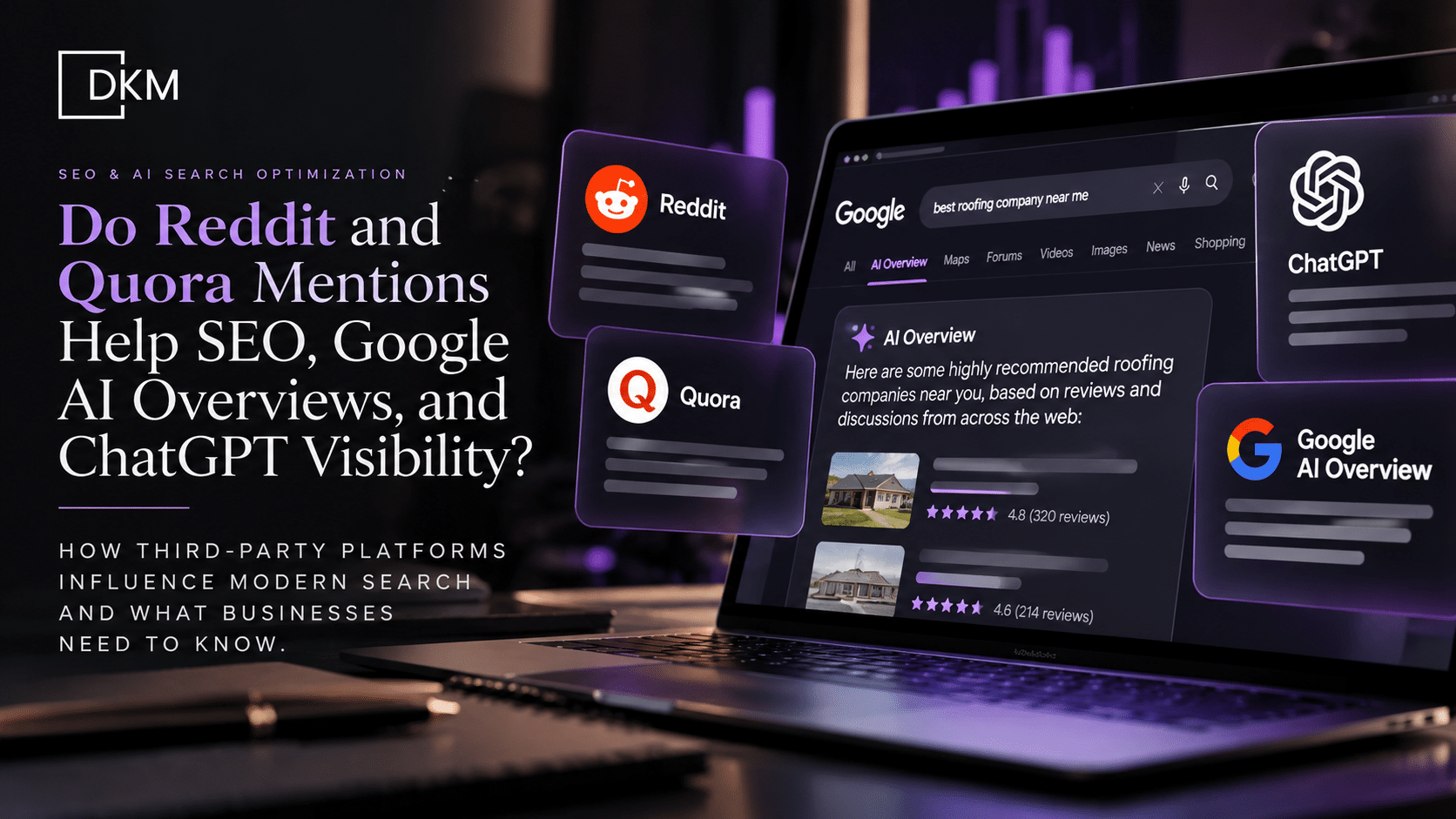
Search engine optimization has changed. Today, businesses need to think beyond their websites and consider how their brands appear across the entire digital landscape.
For years, traditional SEO focused heavily on keywords, backlinks, website optimization, and improving positions in Google's organic search results. Those elements remain important, but the rise of AI-powered search has introduced new opportunities for businesses to be discovered.
Platforms like Reddit, Quora, YouTube, LinkedIn, and industry-specific communities are increasingly part of the online research journey.
But do mentions on these platforms actually help your business rank higher on Google? Can they influence Google AI Overviews or recommendations generated by ChatGPT?
The answer is yes, they can contribute to visibility—but not necessarily in the ways many marketers claim.
Let's examine what businesses need to understand about third-party mentions, AI search, and the evolution of SEO.
Simply mentioning your business on Reddit or Quora does not automatically improve your Google rankings.
Google evaluates websites using numerous systems designed to identify relevant, helpful, and trustworthy content. These systems consider many signals, including content relevance, links, and other indicators.
A Reddit comment mentioning your company is not equivalent to earning a high-quality editorial backlink from a respected industry publication.
However, third-party platforms can support your broader SEO strategy in several ways.
When people encounter your business in relevant online discussions, they become more familiar with your brand.
That exposure may encourage users to visit your website, research your services, or search for your company by name.
Although increased branded search activity is not a guaranteed ranking boost, brand recognition can contribute to stronger overall marketing performance.
A useful answer on Quora or a relevant Reddit discussion may send qualified visitors directly to your website.
These visitors may already be researching a service, comparing providers, or looking for recommendations.
That makes relevant referral traffic valuable even when it does not directly improve organic rankings.
Original insights, helpful resources, and expert contributions can attract attention from bloggers, journalists, and industry publishers.
If those sources independently reference and link to your website, your business may earn valuable editorial backlinks.
The distinction is important: the benefit comes from earning relevant links and exposure, not simply placing your website address in hundreds of discussions.
Yes. Google AI Overviews can use publicly accessible information from third-party websites, including forums and community discussions.
For certain searches, Google may reference Reddit threads, Quora answers, articles, videos, and other relevant sources when generating an AI-powered response.
This creates another opportunity for businesses to appear during the research process.
For example, someone might search:
Depending on the query, Google's AI-powered results may incorporate information from a variety of sources.
If a business is genuinely discussed in relevant, accessible, and credible content, that information may become part of the material an AI system considers.
However, appearing in a discussion does not guarantee that Google will cite the discussion or recommend the business.
AI Overviews are generated dynamically, and their sources and responses may vary.
Potentially, but the relationship is more complicated.
ChatGPT and other AI-powered search tools may use web search and retrieved third-party content to answer questions about businesses, services, and products.
Depending on the system, query, and available sources, these answers may reference online publications, business websites, review platforms, community discussions, and other publicly available information.
Consider a consumer asking an AI assistant to recommend a roofing contractor.
The assistant may have access to information from the contractor's website, business listings, customer reviews, relevant articles, or third-party discussions.
A credible mention of that contractor could provide useful context.
But there is no established formula showing that a certain number of Reddit posts, Quora answers, or brand mentions will cause ChatGPT to recommend a company.
AI visibility is not something businesses can reliably purchase through mass-produced mentions.
Instead, businesses should focus on making accurate, useful, and consistent information about their services available across relevant, trustworthy sources.
Search Everywhere Optimization is a broader marketing approach that recognizes that consumers discover businesses across multiple search engines, platforms, and AI-powered experiences.
Traditional SEO remains essential, but customers do not always begin and end their research on Google.
They may discover a business through YouTube, investigate its reputation on Reddit, compare reviews on Yelp, ask ChatGPT for recommendations, and finally visit its website.
Each interaction can influence whether that customer trusts the business enough to make contact.
An effective Search Everywhere Optimization strategy considers several areas:
Optimizing for Google and Bing through technical SEO, helpful content, website structure, relevant backlinks, and search intent.
Strengthening visibility through Google Business Profile, relevant business directories, accurate information, and customer reviews.
Improving the accessibility, clarity, accuracy, and credibility of business information that AI-powered systems may retrieve and reference.
Building awareness through relevant editorial coverage, expert contributions, interviews, and authoritative industry websites.
Participating in relevant discussions on platforms such as Reddit, Quora, LinkedIn, YouTube, and specialized communities.
The objective is not to appear everywhere indiscriminately.
The objective is to build a credible presence wherever your potential customers research, compare, and evaluate businesses.
Absolutely.
As businesses compete for visibility across traditional and AI-powered search, earning recognition from credible third-party sources remains a valuable marketing strategy.
Digital PR can help businesses secure coverage through:
These activities can strengthen brand recognition, create referral opportunities, and sometimes generate valuable editorial backlinks.
However, not every media mention includes a backlink, and not every backlink carries the same SEO value.
A relevant editorial link from a respected industry publication may be more valuable than dozens of low-quality links created solely for SEO purposes.
Businesses should prioritize relevance, editorial quality, and genuine audience value rather than raw backlink volume.
One of the biggest mistakes businesses make is assuming that every SEO campaign requires the same level of investment.
Consider two roofing companies.
Company A operates in a smaller market where competing websites have limited content, modest backlink profiles, and relatively weak local visibility.
Company B operates in a highly competitive metropolitan area where established roofing companies publish extensive resources, earn media coverage, maintain strong review profiles, and invest consistently in digital marketing.
These businesses face very different competitive environments.
A campaign that produces meaningful improvements for Company A may not be sufficient to close Company B's competitive gaps.
This is why effective SEO should begin with a competitive analysis rather than a generic list of monthly deliverables.
At DigiKai Marketing, we believe SEO strategies should be built around the competitive landscape.
Our Competitive Growth Assessment examines eight critical areas:
This approach helps us identify which opportunities deserve attention and recommend an appropriate SEO strategy and investment.
It also helps businesses understand why their results may differ from competitors operating in other industries or geographic markets.
Not necessarily.
Before investing in community platforms, businesses should determine whether their target customers actually use those platforms to research their services.
A B2B software company may find relevant opportunities in professional communities and technical discussions.
A local roofing contractor may benefit more from strong Google reviews, local media coverage, neighborhood recommendations, and relevant home improvement publications.
The best strategy depends on the industry, customer behavior, and competitive landscape.
Businesses should also avoid:
Authenticity and relevance matter more than simply increasing the number of mentions.
Because third-party visibility does not always translate directly into rankings, businesses need to evaluate multiple performance indicators.
Useful measurements include organic keyword visibility, qualified organic traffic, referral visits, leads, branded search trends, relevant earned backlinks, review growth, and local search performance.
AI search visibility can also be monitored through repeated testing of relevant prompts, source citations, and competitor comparisons.
However, AI-generated responses can change across sessions and users, so these measurements should be treated as directional indicators rather than guaranteed ranking positions.
Ultimately, businesses should evaluate whether their broader visibility strategy is attracting the right audience and generating meaningful business opportunities.
Google rankings still matter. So do backlinks, technical optimization, quality content, and local search.
But modern digital visibility extends beyond a single search engine.
Consumers are discovering businesses through AI assistants, review websites, online communities, videos, publications, and social platforms.
The businesses that succeed will be those that understand where their customers search and develop a credible, useful presence across those channels.
That does not mean every company needs to invest in every platform.
It means the strategy should reflect the market, the competition, and the opportunities most likely to produce measurable value.
At DigiKai Marketing & Advertising, we develop SEO and AI search visibility strategies based on your business goals and competitive environment—not generic promises of first-page rankings.
Our DigiKai Competitive Growth Assessment helps identify where your competitors are stronger, where opportunities exist, and which investments may help your business compete more effectively.
Ready to understand what your business is competing against?
Request Your DigiKai Competitive Growth Assessment
SEO and AI search results vary based on competition, geographic location, website condition, search systems, and ongoing optimization. No specific rankings, AI recommendations, traffic levels, or business outcomes are guaranteed.