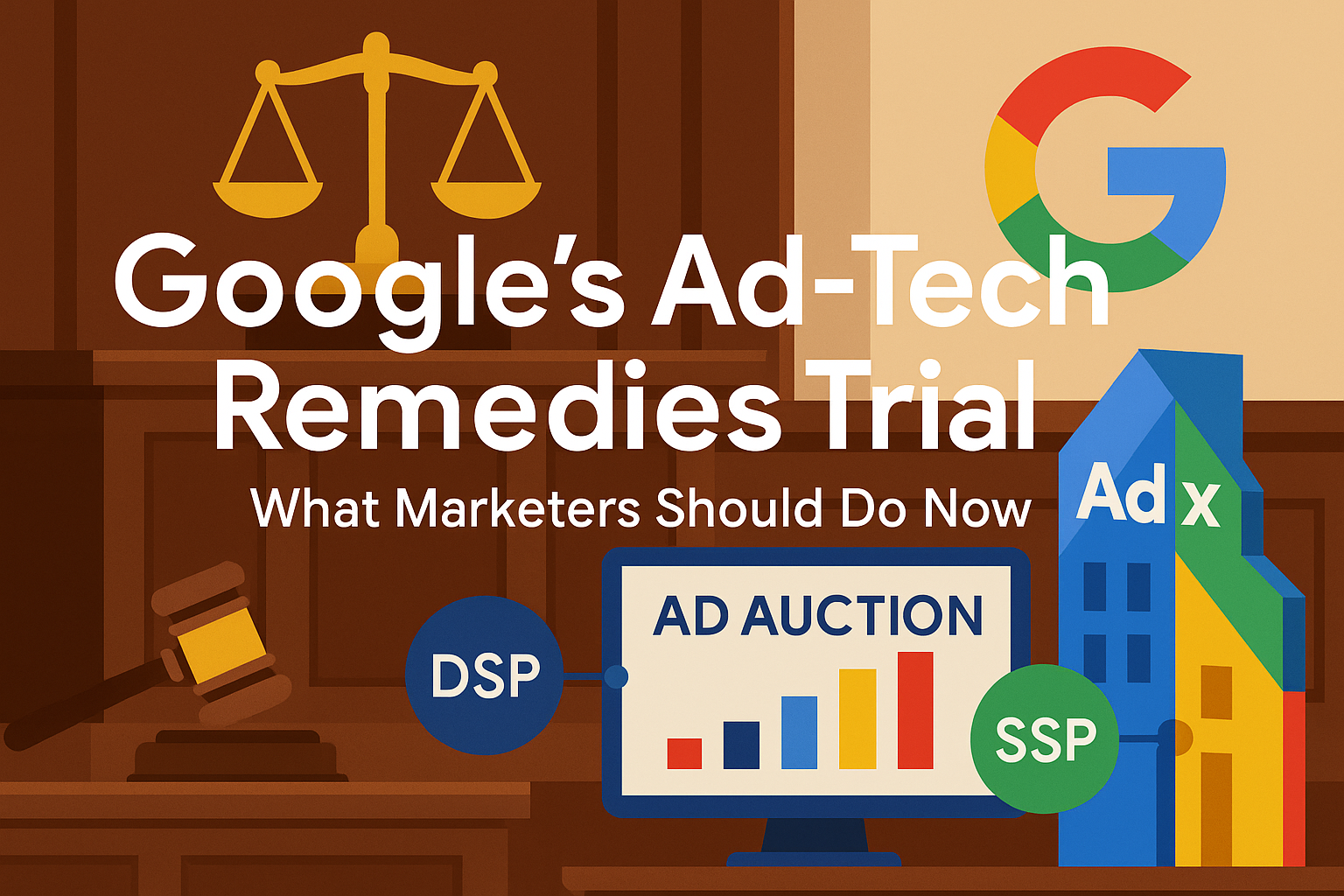
Today (September 22, 2025), Google is back in federal court in Alexandria, VA for the remedies phase of the U.S. Department of Justice’s ad-tech case. The DOJ is pushing for structural changes—including a potential divestiture of Google’s ad exchange (AdX) and parts of its publisher ad stack—arguing that Google’s vertically integrated ad stack harms competition. Google says a breakup is unnecessary and favors lighter, “behavioral” fixes instead. (Reuters)
This trial is separate from the search-monopoly case, where the court issued remedies on September 2, 2025 (no breakup there), and it’s also unfolding alongside the Epic v. Google Play Store saga, where the Ninth Circuit recently refused to further pause an injunction and nudged Google toward compliance. Together, these cases signal a new regulatory climate that marketers can’t ignore. (FGS Global)
The short version (for busy CMOs)
- What’s happening: A two-week remedies trial weighs whether Google must spin off parts of its ads business (e.g., AdX/Google Ad Manager) or accept strict conduct rules. (Reuters)
- Why it matters: Any structural change could alter auction dynamics, fees, and access across Google Ads, DV360, Google Ad Manager/AdX, and third-party exchanges. (Financial Times)
- What to do now: Diversify spend, shore up first-party data, and stress-test your measurement and supply paths so your performance doesn’t hinge on a single walled garden.
What exactly is at stake?
The DOJ argues Google’s ownership of multiple layers of the ad stack (publisher ad server, exchange, and buying tools) lets it self-preference and tilt ad auctions, reducing competition for publishers and advertisers. Proposed remedies reportedly include divesting AdX and even open-sourcing elements of the auction mechanism to restore fairness and transparency. Google counters that a breakup would create chaos and prefers behavioral commitments. The judge will decide which mix of structural (divestitures) and behavioral (rule-based) remedies is appropriate. (Reuters)
Implications for advertisers and publishers
- Auction mechanics & pricing
- If AdX were separated from the rest of Google’s stack, auction routing and fee structures could change (e.g., new take-rates, different clearing behavior, more competition among exchanges). Expect short-term volatility in CPMs while markets recalibrate. (Financial Times)
- Access to inventory
- Depending on the remedy, pathways to Google demand (and YouTube inventory via DV360) could evolve. More open exchange competition could improve reach and transparency—but plan for workflow adjustments if tools are decoupled. (Reuters)
- Reporting & transparency
- Regulators are pressuring for more transparent auctions. If parts of the mechanism become more open, you could see clearer fee disclosure and cleaner supply-chain signaling—good for supply-path optimization (SPO). (Reuters)
- Parallel legal currents
- The search remedies (issued Sep 2) didn’t break up Google but did impose constraints that may influence data-sharing and defaults over time.
- In Epic v. Google, the appeals court declined to further stay the injunction, meaning Android app distribution and billing rules are loosening—another sign the landscape is shifting away from single-platform control. (FGS Global)
What DigiKai recommends (action plan you can implement this week)
1) De-risk your channel mix
- Shift 10–20% of budget into non-Google channels to build resilience: Microsoft Advertising, Meta, Amazon Ads, TikTok, Reddit, and quality programmatic via multiple SSPs.
- Use incrementality testing (geo experiments or holdouts) to verify that diversification adds conversions, not just redistributes them.
2) Double down on first-party data & consent
- Collect and model first-party data (email/SMS, loyalty, content gates).
- Ensure Consent Mode (v2), server-side tagging, and durable IDs are set up so measurement holds up as platforms evolve.
3) Fortify measurement beyond last-click
- Maintain GAds/GA4 conversion models, but cross-check with MMM (lightweight Bayesian or monthly partner studies) and MTA from your ad server/CDP.
- Validate with marketing lift tests (geo or PSA tests) so you’re not flying blind if auction rules or access change.
4) Audit your supply path (SPO) and inventory quality
- Activate ads.txt/app-ads.txt checks, sellers.json validation, and SupplyChain Object reviews.
- Run an SPO audit to prioritize direct paths and trusted exchanges; monitor IVT and made-for-advertising (MFA) exposure.
5) Creative & landing-page resilience
- Keep a test-ready creative library (static + short video) and fast, conversion-optimized landers (<2.5s LCP).
- If auctions wobble, creative performance becomes your shock absorber—fresh variations can salvage ROAS when CPMs fluctuate.
6) Scenario-plan for structural remedies
- If divestiture happens:
- Expect tooling changes in Google Ad Manager/AdX and potential new contracts with alternative exchanges.
- Schedule engineering time for tag updates, line-item migrations, and prebid config tweaks.
- If behavioral remedies only:
- Leverage any new transparency/reporting to refine bid strategies and frequency management.
Watchlist: signals that mean “time to adjust” fast
- Court signals on divestiture vs. behavioral fixes (e.g., judge’s comments, remedy scope). (AP News)
- Changes to AdX / Google Ad Manager documentation (auction rules, fees, integration steps). (Reuters)
- Industry reactions from large publishers/SSPs—if they shift traffic, you’ll see it in win-rates, CPMs, and match rates within days. (Courthouse News)
FAQ
Is this the same as the search case?
No. The search remedies landed on Sep 2, 2025 with no breakup. Today’s trial is about ad tech (AdX/Ad Manager, auctions). Different case, different judge, different remedies. (FGS Global)
Will YouTube or Google Ads stop working?
Highly unlikely. Expect continuity with potential policy/tooling changes and more transparency. We’re building contingency plans either way. (Reuters)
What’s the timeline?
The remedies trial is slated for roughly two weeks; decisions and appeals could stretch longer. We’re monitoring daily and adjusting playbooks as facts solidify. (AP News)
How DigiKai can help
- Channel diversification sprint (14 days): Reallocate spend, launch 2–3 net-new channels, and set up lift tests.
- Measurement hardening: Consent Mode v2, server-side tagging, and an MMM/MTA cross-check you can trust.
- SPO & quality audit: Cut waste, verify supply chains, reduce MFA exposure, and protect brand safety.
- Court-watch briefings: Plain-English updates with concrete to-dos for your stack and media plan.
If you want us to run this as a turnkey playbook for your brand, reach out—this is our lane.
Sources for today’s developments and parallel rulings: Reuters, AP, Financial Times (ad-tech remedies trial); DOJ summary and expert analyses (search remedies); and Ninth Circuit coverage (Epic v. Google).